Lale and Gita's reunion in Bratislava
The Tattooist of AuschwitzLale Sokolov and Gita Furman's reunion in Bratislava is the decisive emotional resolution of their separation after the camps. A chance sighting in a crowded city becomes a carefully suspended recognition scene: Gita sees Lale on a horse-drawn cart, steps into the road, and the two survivors move from stunned disbelief to an explicit declaration of love and a marriage proposal. Their reunion does not erase what happened at Auschwitz and Birkenau, but it gives survival a human destination: each other, a home, and a future they can choose together.
Circumstances of the Reunion
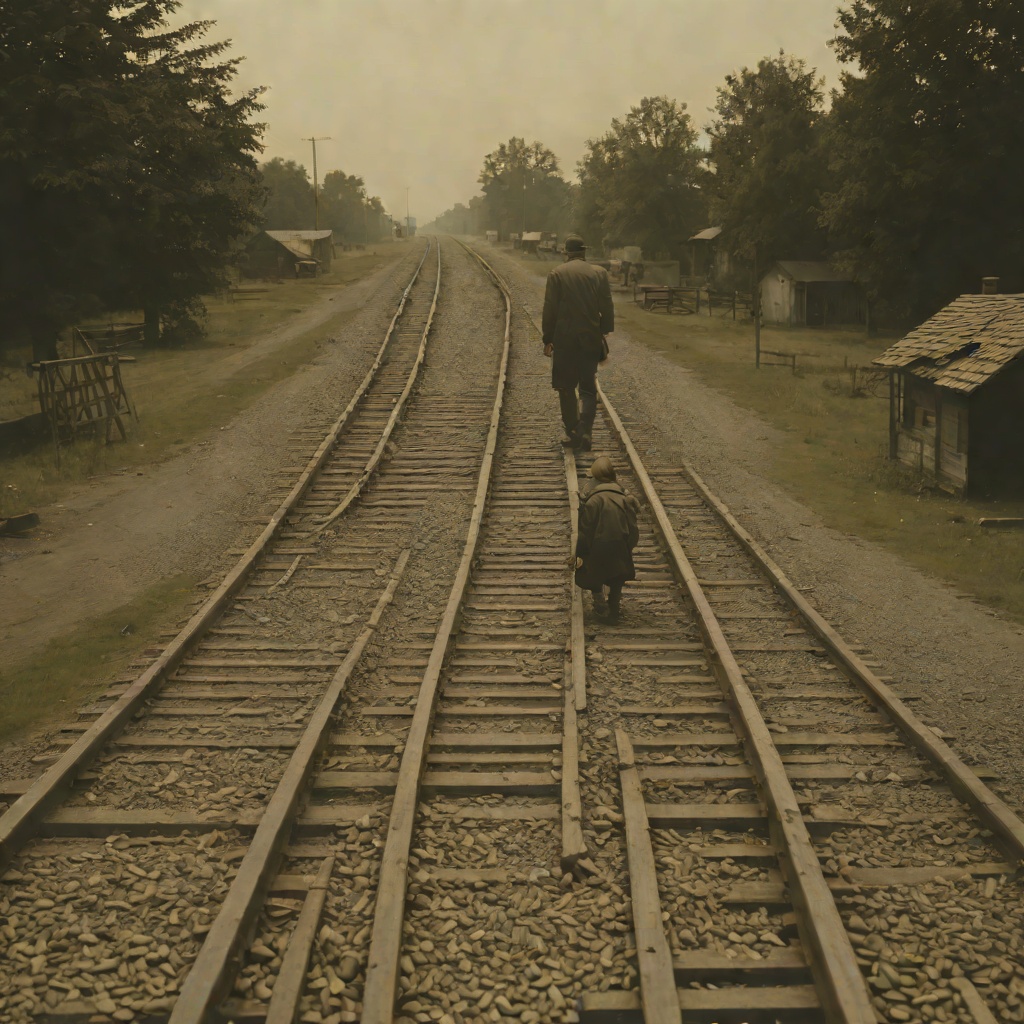
Before the meeting, Lale has been living in Bratislava and searching for evidence that Gita survived. A stationmaster asks whether he has registered her with the Red Cross, whose work includes recording the names of people who are missing, returning, or seeking loved ones. With nothing to lose, Lale goes into the city center to the address he has been given. The reunion therefore grows out of both chance and deliberate searching: the city supplies the unexpected encounter, while Lale's decision to follow the lead makes it possible for him to be there.
The setting sharply contrasts with the camp world they have left behind. Instead of a guarded roll call, a tattooing station, or a transport, Gita is walking down a main street with two friends. Instead of a prisoner number, a uniform, or an official record, the scene is organized around movement, recognition, and personal choice. Yet the past remains present beneath the ordinary street. Lale and Gita had first connected through a brief exchange of looks while he tattooed the final digits of her number, 34902. At that earlier moment, Lale held her arm longer than necessary, forced a small smile, and watched her return a smaller one before she disappeared from his sight. In Bratislava, the look that once had to survive under surveillance can finally become an open meeting.
Recognition in the Street
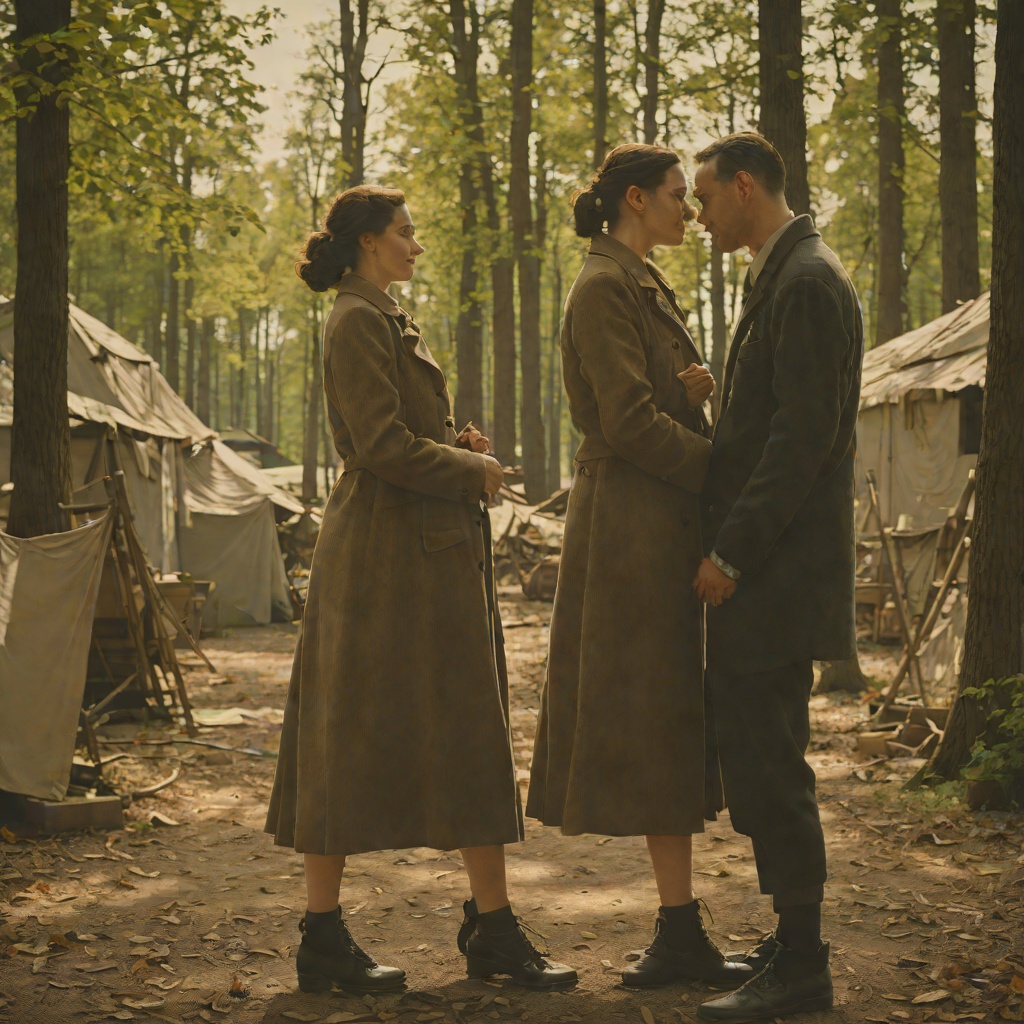
Gita notices a funny-looking cart being drawn by a horse, with a young man standing casually in the back. She steps out onto the road. The horse stops of its own accord in front of her, creating a pause in which the surrounding city seems to fall away. Lale climbs down from the cart, but he does not move toward her. Gita takes one step, then another, while he remains still, apparently unable or unwilling to trust what he is seeing.
Her first word is a simple greeting: “Hello.” Lale responds not with speech but by dropping to his knees. The physical gesture conveys the force of the recognition more completely than an explanation could. Gita turns to her astonished friends, one of whom asks, “Is it him?” She answers, “Yes. It is him.” The exchange confirms the identity that the two lovers themselves can scarcely act upon. Their friends witness not merely a reunion but the recovery of a relationship that had been interrupted by forced transport, camp evacuation, and the destruction of ordinary social life.
Gita then crosses the remaining distance and kneels in front of Lale. She tells him that, in case he did not hear her when they left Birkenau, she loves him. The reference reaches back to their earlier separation and turns an uncertain farewell into a clarified commitment. Her statement is both declaration and repair: she makes audible what the chaos of departure may have left incomplete, and she places love where the camp system had imposed numbers, fear, and disappearance.
Proposal and Immediate Commitment
Lale answers Gita's declaration with a marriage proposal: “Will you marry me?” She replies, “Yes, I will.” The speed of the exchange does not make it shallow. Their relationship has already been formed through danger, secrecy, mutual recognition, and the promise that there would be a tomorrow. The proposal gives that promise a social and practical shape. Marriage becomes the first concrete form of the future they have imagined but could not possess while they were prisoners.
Lale sweeps Gita into his arms and kisses her. One of Gita's friends leads the horse away, allowing the lovers to remain together as the public spectacle of their recognition settles back into ordinary movement. With Gita's arms around Lale's waist and her head resting on his shoulder, they walk away and merge into the crowded street, one young couple among many in a war-ravaged city. The image is deliberately modest after the extremity of their past. They do not leave the city in triumph or receive an official restoration of what was taken from them; they simply walk together, entering the anonymity of civilian life as people whose identities are no longer defined by captivity.
The scene's value shift is stark. Before recognition, Lale's search is governed by uncertainty, and Gita is only a name among the missing. The sight of her changes uncertainty into presence; her declaration changes presence into love; her acceptance changes love into a chosen future. The horse-and-cart encounter also reverses the logic of the transports that once carried prisoners toward death. Here, a vehicle brings Lale toward Gita, and the journey ends not in confinement but in an embrace and a shared walk through the city.
From Reunion to Shared Life
The reunion leads directly into the couple's postwar life. Lale changes his name to Sokolov, the Russian surname of his married sister, because it is more readily accepted than Eisenberg in Soviet-controlled Slovakia. He and Gita marry in October 1945 and establish a home in Bratislava. Their marriage is therefore not an isolated romantic conclusion but the beginning of a sustained rebuilding of identity, domestic life, and economic independence.
Lale starts importing fine fabrics, including linen, silk, and cotton, from throughout Europe and Asia. He sells them to manufacturers who are desperate to rebuild and reclothe the country. His business becomes, according to the account, the only one not immediately nationalized by the communist rulers, because it supplies materials desired by the government hierarchy for personal use. The couple's future thus combines private devotion with the practical improvisation characteristic of their survival. Love does not replace material reality; it accompanies the work of making a life after devastation.
Their later family life is described as intensely devoted. Their son recalls a household full of affection and says that his parents' devotion to each other was total and uncompromising. When he asked how they had remained together for so many years, Gita explained that nobody is perfect, but that Lale had cared for her from the first day they met in Birkenau and would always put her first. The statement gives the Bratislava reunion a long afterlife: the embrace in the street becomes the foundation of a marriage in which care, priority, and physical tenderness remain visible decades later.
Historical and Narrative Significance
The reunion is powerful because it follows scenes in which survival has been reduced to bodily endurance. Lale has witnessed men being forced into a sealed gas van, heard muffled screams, and seen dead bodies fall from it like blocks of stone. He has endured the terror of Block 11, where he spends two days in darkness listening to the cries of other prisoners, and he has known the violence represented by the prisoner number tattooed onto the body. Against that history, Gita's greeting and declaration restore speech and individuality. She is no longer a numbered prisoner disappearing from his view, and he is no longer only the Tätowierer confronting an imposed system of identification.
The reunion also completes the book's movement from an initial glance to a sustained relationship. At their first meeting, Lale's response to Gita is bodily and nearly wordless: her eyes seem to stop and restart his heart, while he can offer only a forced smile before another paper is thrust at him and she is gone. In Bratislava, the earlier visual recognition is answered by spoken love, physical closeness, and a promise of marriage. The narrative turns a moment that once existed under threat into a public and mutual choice.
The account of the reunion is also framed by the tension between memory and historical record. The teller of Lale's story explains that Lale's memories were generally clear and precise, matching research into people, dates, and places, so that memory and history seemed to move together rather than separate. The Bratislava encounter consequently functions as more than a sentimental ending. It is the point at which a survivor's remembered search, a documented postwar life, and the enduring relationship of Lale Sokolov and Gita Furman converge. Their walk into the crowded street does not make the war-ravaged city whole, but it establishes that the future remains possible within it.